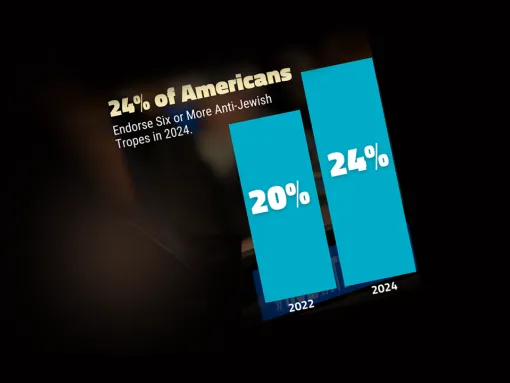
ADL Center for Antisemitism Research's new study - fielded in Jan. 2024 - reveals 24% of Americans harbor extensive antisemitic prejudice, up from 20% in 2022.
Americans Increasingly Aware of and Concerned about Antisemitism
Report
Awareness and concern about antisemitism grew in 2023 due to the Hamas attacks and a rise in antisemitic incidents, as evidenced by a poll of 1,484 US adults.
ADL and CPOST found that trends that raised the greatest risk of antidemocratic violence in recent years are particularly associated with antisemitism.
The Antisemitic Environment: How Social and Media Exposures Predict Antisemitic Beliefs
Report
An analysis of how friends, family, religious institutions, talk radio, pop culture, politicians and social media predict anti-Jewish and anti-Israel attitudes.
Antisemitic Attitudes in America: Topline Findings
Report
In our topline findings, data shows widespread belief in antisemitic conspiracy theories & tropes nearly doubled since 2019 & the highest levels in 30 years.
Research Confirms: Teaching Antisemitism as a Cyclical Conspiracy Theory Works
Article
New research shows the Gringlas Unit effectively teaches students to recognize antisemitism as a recurring conspiracy theory, reducing belief in antisemitic tropes after just one lesson.
Building Student Digital Literacy: ADL Innovation Lab for Educators
Tools and Strategies
Join the ADL Innovation Lab and partner with ADL to equip students with digital literacy skills to combat online mis- and disinformation that lead to hate.
Becoming a Critical Thinker in an AI-Driven World: Media Literacy Strategies for the Classroom
Lesson Plan
ADDITIONAL TERMS FOR EDUCATORS: Generative Artificial Intelligence (GAI): Unlike more traditional AI systems, which are typically designed to recognize patterns in existing data and make predictions based on those patterns, generative artificial intelligence (GAI) systems are designed to produce new content in response to user prompts. These outputs can include text, images, audio or video content. Examples of popular GAI chatbots include Open AI’s ChatGPT and…
When Hate Goes Viral: Bias and Antisemitism on Social Media
Tools and Strategies
It’s critical that parents, caregivers and educators learn more about social media and how to support young people in their understanding of its power and limitations.
Who Leads the Pride: Fostering Student Leadership with Don't Feed the Lion
Article
Don’t Feed the Lion: IntroductionDon’t Feed the Lion by Bianna Golodryga and Yonit Levi explores the story of antisemitism growing at Oakdale Middle School. The story begins with Theo Kaplan, a 13-year-old Chicago middle schooler and soccer captain. Theo’s world is turned upside down when his professional soccer idol, Wes Mitchell, makes an antisemitic comment that goes viral. The situation escalates when Theo discovers a swastika…
Beyond the Podium: Jewish Identity, Antisemitism and the Olympic Games
Article
Every two years, we watch athletes compete on the world stage—and what captivates us isn't just the competition. It's the stories: the struggles, the triumphs, the personal journeys that help us see ourselves and others more clearly. The Olympics offer us a unique opportunity to explore something deeper: the complexities of identity—individual and national. When we bring these conversations into our classrooms, we're teaching students to see the human stories behind the…
Artificial Intelligence: What do Parents, Caregivers and Educators Need to Know?
Tools and Strategies
Help young people use AI critically. Learn how bias and misinformation show up in AI tools, plus conversation starters and activities for families and educators.
Educators should select narratives for their classroom with thought and care—ensuring that history and fact are presented accurately and with as much balance as possible.
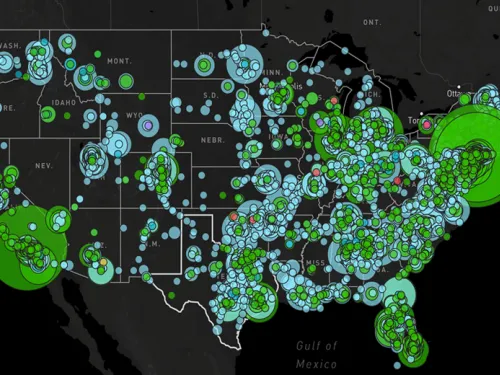
Publicly available maps can be inaccurate or misleading; when used as teaching aids, such biased maps can create a distorted sense of events. For this reason, educators should take care when choosing whether and how to use publicly available maps for instructional purposes, especially when covering complex and ongoing topics.
Resources to facilitate thoughtful conversations with your students about antisemitism, current events and violence, and how we build more communities that stand up to hate.