




New York, NY, March 6, 2026 ... The Anti-Defamation League's (ADL) Task Force on Middle East Minorities issued the following statement regarding the military conflict in Iran: At this moment of profound uncertainty for Iran, we stand in solidarity with the Iranian people and their tireless struggle for their rights, freedom, and dignity. Iran is not the regime that has controlled it for the last 47 years. For more than two millennia, Iran was one of the world's great…
61 Results
Back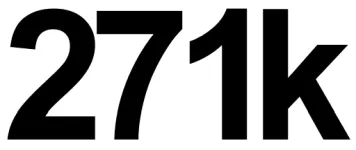
271k is shorthand for a false assertion put forward by Holocaust deniers that only 271,000 Jews died in the Holocaust, rather than 6 million.
Alternate Names: 271,000; 271
271k is an antisemitic shorthand reference to a false claim made by Holocaust deniers that only around 271,000 Jews died during the Holocaust rather than the consensus view, based on exhaustive research, that the Nazis killed approximately six million Jews in their extermination campaign.
The number 271,000 stems from a scanned image of part of a 1979 document often shared by Holocaust deniers. The document originated from what is today known as the Arolsen Archives, based in Germany, one of the largest repositories of records related to victims of Nazi persecution. Often attributed to the Red Cross, which administered the Archives for many years, the document provided then-current statistics on the number of victims at 13 concentration camps that the repository had, upon request, confirmed as dead and issued death certificates for (often needed by next of kin to obtain insurance benefits, pensions, etc.). This number was slightly over 271,000 (Holocaust deniers may also circulate a similar document from 1984 with somewhat higher numbers).
As the Arolsen Archives and others have explained, such documents did not list the total number of Jewish victims at these 13 locations, nor did they include victims from the many other concentration camps, death camps, and slave labor camps operated by the Nazi regime, nor figures for the vast numbers of victims who died in ghettoes or were shot outside of camps, especially in the Soviet Union. Holocaust deniers, however, claim that the 271,000 figure represents the totality of Jews who perished under the Nazi regime; many deniers further assert that most of these victims were not killed by the Nazis but rather died of malnutrition or diseases like typhus because of the chaos and dislocation caused by the Allied strategic bombing of Germany in the final year of the war. In other words, they falsely claim that few Jews died during World War II and that most of the deaths that did occur were the fault of the Allies, not the Nazis.
The 271,000 claim is linked to an older false assertion originating with the West German far right in the 1950s that the Red Cross had ostensibly said Jewish victims of the Nazis had not numbered more than 300,000. The Red Cross has repeatedly refuted that fabricated claim. Holocaust deniers say that Canadian Holocaust denier Ernst Zundel uncovered the “271,000” document in the 1980s and used it (unsuccessfully) to defend himself in Canadian trials over his reprinting of a Holocaust denial pamphlet from Great Britain in the 1970s that repeated the older 300,000 claim. The image of the document was later used by other Holocaust deniers, eventually making its way to the internet, where it spread still further. However, it was not until around 2024 that 271k and 271,000 emerged on social media as popular shorthand references to the false claim and as antisemitic references, generally.
Antisemites often use 271k in response to online posts about the Holocaust or the six million Jews who perished in it. Often it appears in language such as “271k at best,” “271k tops, mostly from typhus” or “271k is the best we can do.” It also frequently appears in Holocaust denial memes designed to suggest that the mass murder of six million Jews in such a short time was impossible. One such meme features a worker in a pizza parlor saying “Six million pizzas? The most we can make is 271k.” Variations replace pizzas with other things, such as tea: “Six million cups in five years? Sorry, the most I can make is 271k.” Other memes feature images from the television show Pawn Stars, depicting pawn shop workers from the show saying, “Best I can do is 271,301.” Some people use it to suggest more Jews should be killed, employing phrases such as “271k is not enough.” Since its introduction, use of 271k as antisemitic shorthand has grown rapidly on social media.
As numbers, 271, 271k and 271,000 may have very different meanings in other contexts; they should always be evaluated carefully in the specific context in which they appear.
The phrase “the Jew cries out in pain even as he strikes you” is a slogan that suggests Jews portray themselves as victims even though they are the ones who ostensibly harm others.
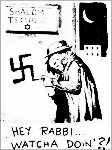
“Hey Rabbi, watcha’ doing?” is an antisemitic slogan used to suggest that Jews invent hate crimes and other outrages against themselves to gain sympathy or profit.
The Anti-Defamation League’s Task Force on Middle East Minorities is deeply troubled by the recent sentencing of Remy Rowhani, a respected Qatari Baha’i, to five years in prison. This decision raises concerns about the treatment of religious minorities in Qatar. Mr. Rowhani, a distinguished citizen who has long served his country, appears to have been singled out because of his faith. We urge the Qatari authorities to consider reversing the sentence and take meaningful steps to…
ADL has been closely tracking how states are addressing antisemitism and supporting their Jewish communities. In 2024, ADL tabulated 9,354 antisemitic incidents across the United States – a 5% increase from 2023, a 344% increase over the past five years, and an 893% increase over the past decade. These numbers underscore the urgent need for state-level action. As highlighted in our first-of-its-kind Jewish Policy Index (JPI), our goal is to provide a tool that advocates, educators and…
April 21, 2025 Letters to the Editor Jewish News Syndicate To the Editor: Dr. Andrew Bostom and Morton Klein conflate facts and distort findings in their attempt to reach their preconceived conclusion that ADL is “hiding” data about antisemitism among Muslim communities (“ADL quietly purged data on European Muslim antisemitism,” April 18). Nothing could be further from the truth. Our surveys have always tracked this data, and our aim has always been to be fully…

A guide of best practices for school decision makers in their work to counter antisemitism in K-12 schools.
The ongoing military conflict in Iran has the potential to reshape the country, not least for its diverse range of religious and ethnic minorities. While Iran has a deep and ancient history of religious and ethnic pluralism, the 1979 revolution set in motion almost five-decades of systematic persecution against the country's minority communities and Iranian women in the name of the Islamic Republic. Since 1979, the Islamic Republic has imposed a theocratic order…

Use this collection of classroom activities about holidays and observances to enhance students' understanding of our multicultural society and world.
The phrase “You Will Not Replace Us” is a white supremacist slogan referring to the common White supremacist belief that the white race is in danger of going extinct due to rising numbers of non-White people who are controlled and manipulated by Jews. It may also be seen in acronym form as YWNRU.
ALTERNATE NAMES: YWNRU, Jews Will Not Replace Us
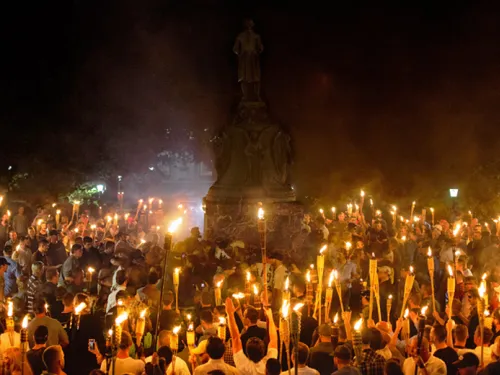
“You Will Not Replace Us” is a white supremacist slogan that became popular in early 2017, as did its acronym version, YWNRU. The slogan appeared on White supremacist flyers, banners and graffiti in a variety of places in the first six months of 2017, gaining wider attention when white supremacists used the phrase at several rallies held in Charlottesville, Virginia, culminating in the large and violent Unite the Right event in August 2017.
The slogan is a reference to the popular white supremacist belief that the white race is in danger of extinction by a rising tide of non-Whites who are controlled and manipulated by Jews (in fact, one variant of “You Will Not Replace Us” is “Jews Will Not Replace Us”).
“You Will Not Replace Us” may have been derived in part from “The Great Replacement,” a theory promoted by French writer Renaud Camus in a 2012 book of the same name. Camus argued that Europe was being overrun by mass migration of black and/or Muslim immigrants from outside Europe, who would replace traditional European culture with their own “alien” culture. Such arguments evolved into “replacement theory,” which became popular with the far right in several European countries, especially among Identitarians. Replacement theory was promoted as early as 2015 by American white supremacist groups such as Generation Identity U.S.A.
The phrase “We Wuz Kangs” is a racist term meant to attack African-Americans by racist mockery of Afrocentric theories about Egyptian connections to sub-Saharan Africa.
ALTERNATE NAMES: We Wuz Kings, Kings N Shiet
“We Wuz Kangs” is a racist catchphrase and collection of memes directed at African-Americans and other people of sub-Saharan African descent. Originating in 2015 and popularized by the website 4chan, the phrase is a racist shorthand reference to discredited but popular Afrocentric theories that claimed sub-Saharan Africans were descended from ancient Egyptians.
The phrase and meme are intended to mock the Afrocentric theories and, by extension, anyone who might believe in them. Users employ phrases such as “We Wuz Kangs,” “We Wuz Kings,” and “Kings N Shiet,” featuring mock black American dialect that is intended to portray blacks as ignorant and a contrast to the ostensibly more civilized ancient Egyptians. Meme versions of the phrase similarly tend to feature images with racist stereotypes of black people, often contrasted with images of Egyptian pharaohs. The overall intent is to portray blacks as crude, ignorant and uncivilized.
Memes featuring the phrase often include an image of an African leader taken from The African Kingdoms expansion of the video game Age of Empires II, which debuted around the time the meme was created in 2015. Usage of the meme seemed to increase with the release of the popular movie Black Panther in 2018.
The phrase “The Goyim Know” is an antisemitic phrase portraying the ostensible reaction of Jews when their supposedly conspiratorial or manipulative misdeeds are revealed to the public. Often combined with “Shut It Down.”
ALTERNATE NAMES: Da Goyim Know
“The Goyim Know” is an antisemitic catchphrase, used by itself or combined with the related phrase “shut it down,” as in “Oy vey, the Goyim know! Shut it down!” An alternate version is “Da Goyim Know.” It is most associated with the alt right segment of the white supremacist movement and message boards such as 4chan and 8chan.
The language is typically used in references to antisemitic conspiracy theories depicting Jews as malevolent puppet-masters, manipulating the media, banks, and even entire governments to the benefit of themselves but to the detriment of other peoples. The phrase is intended to be understood as spoken by a panicked Jew responding to some occurrence that would ostensibly reveal Jewish manipulations or deceit to non-Jews (i.e., “goyim,” a disparaging Yiddish and Hebrew word for non-Jews).
The implied Jewish speaker in the catchphrase is thus urging fellow Jews to shut down that particular manipulation or deceit and move on to something else. “Can’t let the gullible goyim know that they are supporting free cellphones and internet connections to the boys in the hood,” reads one typical posting from 2012 on the white supremacist website Stormfront. “The Goyim know” meme originated as mocking shorthand for this type of language.
The earliest known references to “The Goyim Know/Shut It Down” appeared in 2013, apparently originating on the discussion forum 4chan. The phrases quickly spread to social media. The meme became more popular in 2014 after an antisemitic song parody featured the phrase. Soon the meme became a staple of online antisemitism.
It didn’t take long before the phrase entered the physical world. In 2017, white supremacists appeared with signs featuring the phrase “The Goyim Know” at several events around the country, including the August 2017 “Unite the Right” rally in Charlottesville, Virginia. The intent behind the “The Goyim Know” signs seemed to be to demonstrate that white supremacists were aware of the conspiracies in which Jews were ostensibly involved.
“Six Gorillion” is an antisemitic phrase used by white supremacists to refer to the Jews who died during the Holocaust (typically thought to be around six million). They replace “million” with “gorillion” to give the impression that Jews wildly exaggerate Holocaust-related deaths.
ALTERNATE NAMES: Muh Six Gorillion
The term “Six Gorillion” or “Muh Six Gorillion” is an antisemitic reference associated primarily with the alt right segment of the white supremacist movement. It entered common use by anti-Semites and white supremacists in 2013 and has been increasingly popular thereafter.
Both variations of the phrase refer to the approximately six million Jews who were killed during the Holocaust. The phrase replaces “million” with the nonsensical “gorillion” to convey the impression that Jews wildly exaggerate the number of people who died during the Holocaust.
The variation “Muh Six Gorillion” employs the slang word “muh,” a version of “my” meant to convey whining or complaining; references to “Muh Six Gorillion” are intended to suggest that Jews whine or complain about the Holocaust, including gratuitously bringing up the Holocaust in order to deflect criticism. This usage is also a variant of the antisemitic phrase “Muh Holocaust.”
“Muh Holocaust” is an antisemitic phrase popular with the alt right used to convey the bigoted notion that Jews routinely bring up the Holocaust to gain attention or to deflect negative attention.
“It’s okay to be white” is a slogan popularized on the website 4chan in 2017 for trolling purposes and which was soon adopted by white supremacists (who had occasionally used the phrase themselves in the past).
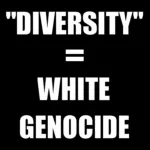
“Diversity = White Genocide” is a white supremacist slogan intended to suggest that multiculturalism will mean the death of the White race.
“Day of the Rope” is a white supremacist slogan referring to mass murders of “race traitors” that occur in The Turner Diaries, a novel written by neo-Nazi William Pierce. The slogan is typically used to urge or promise some similar scenario in the real world.
“Anudda Shoah” is an antisemitic phrase used by white supremacists to mock Jews, whom they claim bring up the Holocaust when confronted with anything they don’t like.
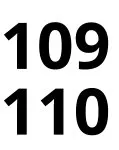
The figure 109 is white supremacist numeric shorthand for the number of countries antisemites claim Jews have been expelled from. In calling for the expulsion of Jews from the U.S., they often refer to the U.S. as the 110th.