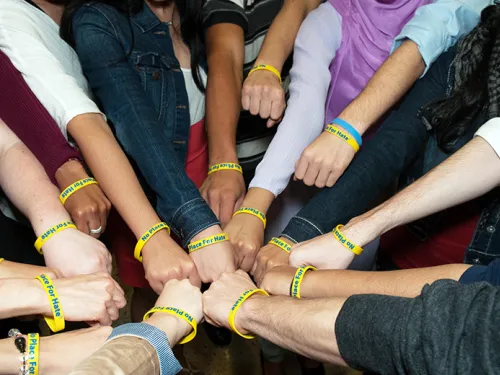



These suggested No Place for Hate® activities are differentiated for elementary, middle and high school students. The activities can be used as a follow-up to watching the webinar, “Connecting Stories and Legacies: A Conversation with Author Gordon Korman and Rachelle Goldstein” which aired on 2/11/25. To make this a NPFH activity towards designation, watch the video, engage students in a discussion using the discussion questions and do one of the additional activities included…
120 Results
Back
About Stories That MatterStories That Matter is a collection of digital teaching kits for K-12 educators and families. Each kit pairs curated books with flexible curriculum ideas and discussion tools to explore Jewish identity, the Holocaust and antisemitism. Books are powerful teaching tools. They can serve as windows into the lives and histories of others, mirrors that reflect students’ own identities and experiences, and doors that invite readers into new perspectives and…
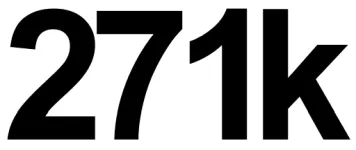
271k is shorthand for a false assertion put forward by Holocaust deniers that only 271,000 Jews died in the Holocaust, rather than 6 million.
Alternate Names: 271,000; 271
271k is an antisemitic shorthand reference to a false claim made by Holocaust deniers that only around 271,000 Jews died during the Holocaust rather than the consensus view, based on exhaustive research, that the Nazis killed approximately six million Jews in their extermination campaign.
The number 271,000 stems from a scanned image of part of a 1979 document often shared by Holocaust deniers. The document originated from what is today known as the Arolsen Archives, based in Germany, one of the largest repositories of records related to victims of Nazi persecution. Often attributed to the Red Cross, which administered the Archives for many years, the document provided then-current statistics on the number of victims at 13 concentration camps that the repository had, upon request, confirmed as dead and issued death certificates for (often needed by next of kin to obtain insurance benefits, pensions, etc.). This number was slightly over 271,000 (Holocaust deniers may also circulate a similar document from 1984 with somewhat higher numbers).
As the Arolsen Archives and others have explained, such documents did not list the total number of Jewish victims at these 13 locations, nor did they include victims from the many other concentration camps, death camps, and slave labor camps operated by the Nazi regime, nor figures for the vast numbers of victims who died in ghettoes or were shot outside of camps, especially in the Soviet Union. Holocaust deniers, however, claim that the 271,000 figure represents the totality of Jews who perished under the Nazi regime; many deniers further assert that most of these victims were not killed by the Nazis but rather died of malnutrition or diseases like typhus because of the chaos and dislocation caused by the Allied strategic bombing of Germany in the final year of the war. In other words, they falsely claim that few Jews died during World War II and that most of the deaths that did occur were the fault of the Allies, not the Nazis.
The 271,000 claim is linked to an older false assertion originating with the West German far right in the 1950s that the Red Cross had ostensibly said Jewish victims of the Nazis had not numbered more than 300,000. The Red Cross has repeatedly refuted that fabricated claim. Holocaust deniers say that Canadian Holocaust denier Ernst Zundel uncovered the “271,000” document in the 1980s and used it (unsuccessfully) to defend himself in Canadian trials over his reprinting of a Holocaust denial pamphlet from Great Britain in the 1970s that repeated the older 300,000 claim. The image of the document was later used by other Holocaust deniers, eventually making its way to the internet, where it spread still further. However, it was not until around 2024 that 271k and 271,000 emerged on social media as popular shorthand references to the false claim and as antisemitic references, generally.
Antisemites often use 271k in response to online posts about the Holocaust or the six million Jews who perished in it. Often it appears in language such as “271k at best,” “271k tops, mostly from typhus” or “271k is the best we can do.” It also frequently appears in Holocaust denial memes designed to suggest that the mass murder of six million Jews in such a short time was impossible. One such meme features a worker in a pizza parlor saying “Six million pizzas? The most we can make is 271k.” Variations replace pizzas with other things, such as tea: “Six million cups in five years? Sorry, the most I can make is 271k.” Other memes feature images from the television show Pawn Stars, depicting pawn shop workers from the show saying, “Best I can do is 271,301.” Some people use it to suggest more Jews should be killed, employing phrases such as “271k is not enough.” Since its introduction, use of 271k as antisemitic shorthand has grown rapidly on social media.
As numbers, 271, 271k and 271,000 may have very different meanings in other contexts; they should always be evaluated carefully in the specific context in which they appear.
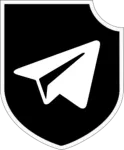
Terrorgram is a white supremacist network formed to incite violent acts to bring about the collapse of society. It has used several logos, which generally include a Waffen SS shield.
Alternate Names: Terrorgram Collective, Terrorgram Network
Terrorgram emerged in the late 2010s as a loose international network of white supremacist individuals and groups, typically neo-Nazi in nature, seeking to promote violent acts in the service of white supremacist accelerationism. White supremacist accelerationism is a school of thought within the white supremacist movement that argues the only way to create a desired whites-only or white-dominated society is to destabilize and destroy current society through violence and disruption, then build a new society from its ashes. Terrorgram—taking its name from the internet platform Telegram, on which it conducted most of its activities—dedicated itself to accelerationist propaganda, glorifying white supremacist mass killers like Dylann Roof and Brenton Tarrant as “saints” and urging others to follow in their footsteps to commit terrorist attacks and hate crimes against minorities and other targets, such as infrastructure. Their propaganda efforts included producing several lengthy and distinctively illustrated manuals with motivational screeds as well as ostensibly practical advice for would-be terrorists.
In 2024, the U.S. designated Terrorgram as Specially Designated Global Terrorists; later that year, the FBI arrested two key American Terrorgram leaders on a number of charges. The arrests precipitated Terrorgram’s collapse as the network’s remaining members sought to avoid infiltration or identification. However, Terrorgram’s digital publications are still in circulation among accelerationists, meaning that people can still encounter their symbols. Terrorgram logos imitate a Waffen SS divisional shield design, though with their own distinct symbology. One simply features a paper airplane, while a different logo depicts a swastika, an infinity symbol, and a ski mask. A third version features the swastika and ski mask along with part of a Sonnenrad symbol.
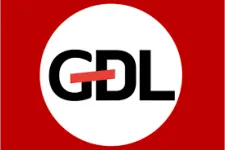
The Goyim Defense League is an antisemitic hate group that employs logos with the letters “GDL” or GTV” in designs resembling the Nazi flag.
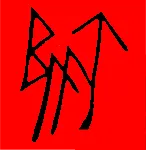
Blood Tribe is a neo-Nazi group that uses a logo featuring the German word “Blut” (blood) written with runic characters.
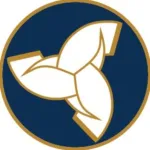
The Asatru Folk Assembly is a white supremacist Norse pagan group that uses a logo consisting of three intertwined drinking horns against a blue background.
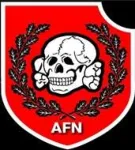
The American Freedom Network is a white supremacist group that uses a logo featuring a red Waffen SS shield and a Totenkopf skull.
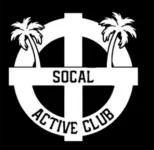
Active Clubs are a network of white supremacist groups that focus on fitness and training. Their logos generally use a Celtic Cross motif.
Jonathan Greenblatt
CEO and National Director
July 27, 2022
Dear Mr. Agrawal,
I am once again reaching out regarding Iranian Supreme Leader Ali Khamenei’s chronic violations of Twitter’s terms of service on his accounts of Iranian Supreme Leader Ali Khamenei. We ask that you de-platform him for his continued use of Twitter to promote antisemitism, hate, violence and Holocaust denial.
As I wrote in January 2021 to then Twitter CEO Jack Dorsey, Khamenei…

The author and publishers of a new book on Anne Frank's plight have turned one of the few at least partially upbeat stories of Jewish life and thought during the Holocaust into one of Jewish perfidy and treachery. The timing couldn’t be worse: antisemitism is flourishing once again, and Holocaust memory is diminishing.
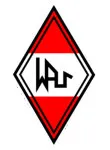
Women for Aryan Unity (WAU) is a longstanding white supremacist group for women. Its logo is a diamond featuring red and white stripes and stylized letters spelling “WAU.”
ALTERNATE NAMES: WAU
Group Status: Current
Women for Aryan Unity (WAU) is a longstanding white supremacist group, founded in 1990, notable for being one of the only female-only white supremacist groups of recent decades. WAU promotes and supports women in the white supremacist movement, typically from a traditionalist vantage point, with content in its newsletters and websites focusing on “women’s” issues, such as raising children.
WAU has also long provided support to white supremacist prison inmates, particularly those viewed as “prisoners of war,” i.e., inmates whose crimes were related to their white supremacist ideology. In particular, WAU has supported the imprisoned members of The Order, aka Brüder Schweigen, a violent 1980s white supremacist terrorist group, providing an outlet for their writings and creating an “Adopt a Brüder” campaign to raise money to give to jailed Order members.
WAU’s logo is a diamond featuring stylized letters spelling “WAU.” The interior of the diamond also features two red stripes and one white stripe. The red-black-white color scheme uses the color scheme of the Nazi flag. Most WAU members practice racist versions of modern Norse paganism and thus may use many Norse pagan symbols as well.
Though started in the United States, for most of its history WAU has also had chapters in other countries; current chapters include Australia, Argentina, Italy and Spain. The logo of WAU’s Argentina chapter replaces the red-black-white color scheme with a blue-white color scheme based on the flag of Argentina.
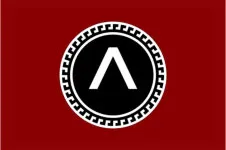
The Shield Wall Network (SWN) is a small, Arkansas-based white supremacist group that uses a Greek lambda (an upside-down V) as its symbol.
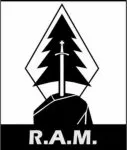
The Rise Above Movement (RAM) is a California-based alt right white supremacist group with a fitness and martial arts emphasis. Its logo features a sword stuck into a boulder; the sword also serves as the trunk of a tree.
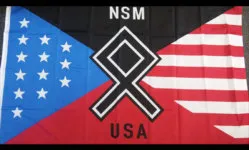
The National Socialist Movement (NSM) is a longstanding neo-Nazi group that has changed its logo several times during its existence. Older versions of its logo can still be found on clothing, printed materials, and even tattoos.
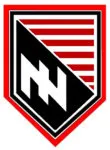
The National Socialist Legion is a small neo-Nazi group that originated in 2018. Its logo features a red, black and white shield with stripes and a Wolfsangel.
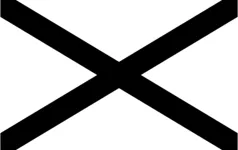
The League of the South is a longstanding neo-Confederate white supremacist group that advocates for an independent, white-dominated South. Its symbol is intended to resemble the St. Andrew’s Cross on the Confederate flag.
ALTERNATE NAMES: Southern Nationalist Flag, Black Cross
Read more about League of the South
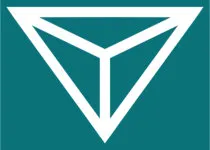
Identity Evropa was one of the most active white supremacist groups in the U.S. from 2016-19. In 2019, it reformed itself as the American Identitarian Movement (AIM).
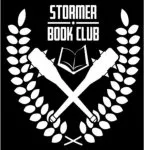
Daily Stormer Book Clubs are mostly informal groups of supporters of white supremacist propagandist Andrew Anglin, who runs the Daily Stormer website.
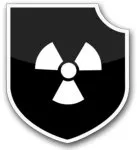
Atomwaffen Division is a neo-Nazi group that emerged in 2016. “Atomwaffen” is the German word for atomic weapons and the group’s logo features a radiation warning symbol on a Waffen SS divisional insignia shield.