





Some supporters of the 2023 Hamas-led terror attacks in Israel have adopted paraglider imagery to celebrate the attacks, as Hamas operatives used gliders to land in Israel to commit violent acts.
98 Results
Back



Alternate Names: NLYS
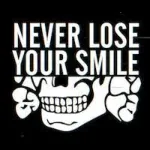
Never Lose Your Smile is a design/meme consisting of the phrase “Never Lose Your Smile” accompanied by the Totenkopf skull image or, more commonly, merely the bottom half of that skull, which obscures its true nature and thus allows the image to pass unnoticed as a white supremacist symbol. The deceptive nature of this design has also allowed extremists to sell clothing, patches, and other items featuring the image on major internet platforms without triggering moderation.
Some Never Lose Your Smile images may also contain the colors or designs of national flags. Other variations use Totenkopf imagery with a slightly different phrase, such as “Never Lose Your Love” or “Never Lose Your Hope.”
Some white supremacists have also used the phrase alone, without the skull, in circumstances such as screen names. However, use of the phrase by itself without a clear white supremacist context should not be taken for granted as hate-related.
White supremacists likely borrowed this concept from older, non-extremist designs that combined the phrase with non-Totenkopf skull images. Use of the “Never Lose Your Smile” slogan in combination with generic skulls or other non-white supremacist images, such as generic clowns, should not be considered hate related.



ALTERNATE NAMES: YWNRU, Jews Will Not Replace Us
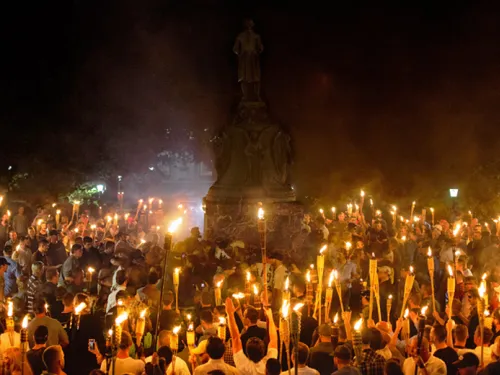
“You Will Not Replace Us” is a white supremacist slogan that became popular in early 2017, as did its acronym version, YWNRU. The slogan appeared on White supremacist flyers, banners and graffiti in a variety of places in the first six months of 2017, gaining wider attention when white supremacists used the phrase at several rallies held in Charlottesville, Virginia, culminating in the large and violent Unite the Right event in August 2017.
The slogan is a reference to the popular white supremacist belief that the white race is in danger of extinction by a rising tide of non-Whites who are controlled and manipulated by Jews (in fact, one variant of “You Will Not Replace Us” is “Jews Will Not Replace Us”).
“You Will Not Replace Us” may have been derived in part from “The Great Replacement,” a theory promoted by French writer Renaud Camus in a 2012 book of the same name. Camus argued that Europe was being overrun by mass migration of black and/or Muslim immigrants from outside Europe, who would replace traditional European culture with their own “alien” culture. Such arguments evolved into “replacement theory,” which became popular with the far right in several European countries, especially among Identitarians. Replacement theory was promoted as early as 2015 by American white supremacist groups such as Generation Identity U.S.A.

ALTERNATE NAMES: Archangel Michael's Cross, Iron Guard
St. Michael’s Cross, despite its name, is not a traditional Christian symbol but rather a fascist symbol designed by Corneliu Codreanu (1899-1938), a Romanian right-wing extremist who led the Iron Guard/Legion of St. Michael movement (also known as the Legion of the Archangel Michael) in the 1920s and 1930s. This symbol became the Iron Guard’s logo until the movement was destroyed during World War II.
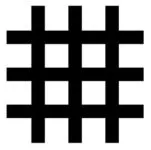
The Iron Guard combined fascism, nationalism, Eastern Orthodox Christianity and anti-Semitism. Its symbol, St. Michael’s Cross, consists of three vertical lines and three horizontal lines arranged in a hashtag-like pattern. The design was intended to resemble both a cross as well as stylized prison bars; Codreanu was allegedly inspired by either an icon or a vision of St. Michael during his time in prison in the 1920s. The color green is also often associated with the Iron Guard, because of the green uniforms worn by its members (sometimes called “Green Shirts”).
After the end of World War II, right-wing extremists in Western Europe resurrected many of the symbols of fascist movements of the interwar era; following the collapse of communism in Eastern Europe, a similar process occurred in that region. In Romania, right-wing extremists revived St. Michael’s Cross.
Unlike many other fascist or Nazi symbols originating in Europe, the St. Michael’s Cross symbol did not spread much overseas. In the late 2010s, however, some American white supremacists – most notably Matthew Heimbach, who headed a short-lived neo-Nazi group called the Traditionalist Worker Party – “discovered” Codreanu and the Iron Guard, as well as its symbology. Like Codreanu, Heimbach was an avowed adherent of Eastern Orthodox Christianity. A few other American white supremacists trying to blend traditional Christianity with their racist and anti-Semitic beliefs also discovered Codreanu, whose memoirs had been translated into English.
The St. Michael’s Cross symbol received more attention in 2019 following Australian white supremacist Brenton Tarrant’s deadly shooting spree targeting two mosques in Christchurch, New Zealand. Tarrant had painted white supremacist and anti-Muslim symbols and references on various firearms and ammo magazines that he brought with him on his rampage; one of the firearms featured a version of St. Michael’s Cross.