



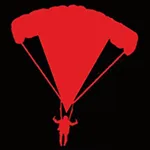
Some supporters of the 2023 Hamas-led terror attacks in Israel have adopted paraglider imagery to celebrate the attacks, as Hamas operatives used gliders to land in Israel to commit violent acts.
158 Results
Back

Alternate Names: Terrorgram Collective, Terrorgram Network
Terrorgram emerged in the late 2010s as a loose international network of white supremacist individuals and groups, typically neo-Nazi in nature, seeking to promote violent acts in the service of white supremacist accelerationism. White supremacist accelerationism is a school of thought within the white supremacist movement that argues the only way to create a desired whites-only or white-dominated society is to destabilize and destroy current society through violence and disruption, then build a new society from its ashes. Terrorgram—taking its name from the internet platform Telegram, on which it conducted most of its activities—dedicated itself to accelerationist propaganda, glorifying white supremacist mass killers like Dylann Roof and Brenton Tarrant as “saints” and urging others to follow in their footsteps to commit terrorist attacks and hate crimes against minorities and other targets, such as infrastructure. Their propaganda efforts included producing several lengthy and distinctively illustrated manuals with motivational screeds as well as ostensibly practical advice for would-be terrorists.
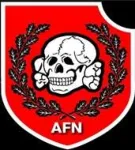
In 2024, the U.S. designated Terrorgram as Specially Designated Global Terrorists; later that year, the FBI arrested two key American Terrorgram leaders on a number of charges. The arrests precipitated Terrorgram’s collapse as the network’s remaining members sought to avoid infiltration or identification. However, Terrorgram’s digital publications are still in circulation among accelerationists, meaning that people can still encounter their symbols. Terrorgram logos imitate a Waffen SS divisional shield design, though with their own distinct symbology. One simply features a paper airplane, while a different logo depicts a swastika, an infinity symbol, and a ski mask. A third version features the swastika and ski mask along with part of a Sonnenrad symbol.
Alternate Names: NLYS
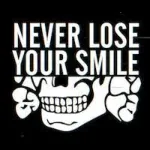
Never Lose Your Smile is a design/meme consisting of the phrase “Never Lose Your Smile” accompanied by the Totenkopf skull image or, more commonly, merely the bottom half of that skull, which obscures its true nature and thus allows the image to pass unnoticed as a white supremacist symbol. The deceptive nature of this design has also allowed extremists to sell clothing, patches, and other items featuring the image on major internet platforms without triggering moderation.
Some Never Lose Your Smile images may also contain the colors or designs of national flags. Other variations use Totenkopf imagery with a slightly different phrase, such as “Never Lose Your Love” or “Never Lose Your Hope.”
Some white supremacists have also used the phrase alone, without the skull, in circumstances such as screen names. However, use of the phrase by itself without a clear white supremacist context should not be taken for granted as hate-related.
White supremacists likely borrowed this concept from older, non-extremist designs that combined the phrase with non-Totenkopf skull images. Use of the “Never Lose Your Smile” slogan in combination with generic skulls or other non-white supremacist images, such as generic clowns, should not be considered hate related.


ALTERNATE NAMES: WAU
Group Status: Current
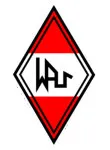
Women for Aryan Unity (WAU) is a longstanding white supremacist group, founded in 1990, notable for being one of the only female-only white supremacist groups of recent decades. WAU promotes and supports women in the white supremacist movement, typically from a traditionalist vantage point, with content in its newsletters and websites focusing on “women’s” issues, such as raising children.
WAU has also long provided support to white supremacist prison inmates, particularly those viewed as “prisoners of war,” i.e., inmates whose crimes were related to their white supremacist ideology. In particular, WAU has supported the imprisoned members of The Order, aka Brüder Schweigen, a violent 1980s white supremacist terrorist group, providing an outlet for their writings and creating an “Adopt a Brüder” campaign to raise money to give to jailed Order members.
WAU’s logo is a diamond featuring stylized letters spelling “WAU.” The interior of the diamond also features two red stripes and one white stripe. The red-black-white color scheme uses the color scheme of the Nazi flag. Most WAU members practice racist versions of modern Norse paganism and thus may use many Norse pagan symbols as well.
Though started in the United States, for most of its history WAU has also had chapters in other countries; current chapters include Australia, Argentina, Italy and Spain. The logo of WAU’s Argentina chapter replaces the red-black-white color scheme with a blue-white color scheme based on the flag of Argentina.
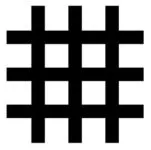
ALTERNATE NAMES: Archangel Michael's Cross, Iron Guard
St. Michael’s Cross, despite its name, is not a traditional Christian symbol but rather a fascist symbol designed by Corneliu Codreanu (1899-1938), a Romanian right-wing extremist who led the Iron Guard/Legion of St. Michael movement (also known as the Legion of the Archangel Michael) in the 1920s and 1930s. This symbol became the Iron Guard’s logo until the movement was destroyed during World War II.
The Iron Guard combined fascism, nationalism, Eastern Orthodox Christianity and anti-Semitism. Its symbol, St. Michael’s Cross, consists of three vertical lines and three horizontal lines arranged in a hashtag-like pattern. The design was intended to resemble both a cross as well as stylized prison bars; Codreanu was allegedly inspired by either an icon or a vision of St. Michael during his time in prison in the 1920s. The color green is also often associated with the Iron Guard, because of the green uniforms worn by its members (sometimes called “Green Shirts”).
After the end of World War II, right-wing extremists in Western Europe resurrected many of the symbols of fascist movements of the interwar era; following the collapse of communism in Eastern Europe, a similar process occurred in that region. In Romania, right-wing extremists revived St. Michael’s Cross.
Unlike many other fascist or Nazi symbols originating in Europe, the St. Michael’s Cross symbol did not spread much overseas. In the late 2010s, however, some American white supremacists – most notably Matthew Heimbach, who headed a short-lived neo-Nazi group called the Traditionalist Worker Party – “discovered” Codreanu and the Iron Guard, as well as its symbology. Like Codreanu, Heimbach was an avowed adherent of Eastern Orthodox Christianity. A few other American white supremacists trying to blend traditional Christianity with their racist and anti-Semitic beliefs also discovered Codreanu, whose memoirs had been translated into English.
The St. Michael’s Cross symbol received more attention in 2019 following Australian white supremacist Brenton Tarrant’s deadly shooting spree targeting two mosques in Christchurch, New Zealand. Tarrant had painted white supremacist and anti-Muslim symbols and references on various firearms and ammo magazines that he brought with him on his rampage; one of the firearms featured a version of St. Michael’s Cross.